
Barometer Bush
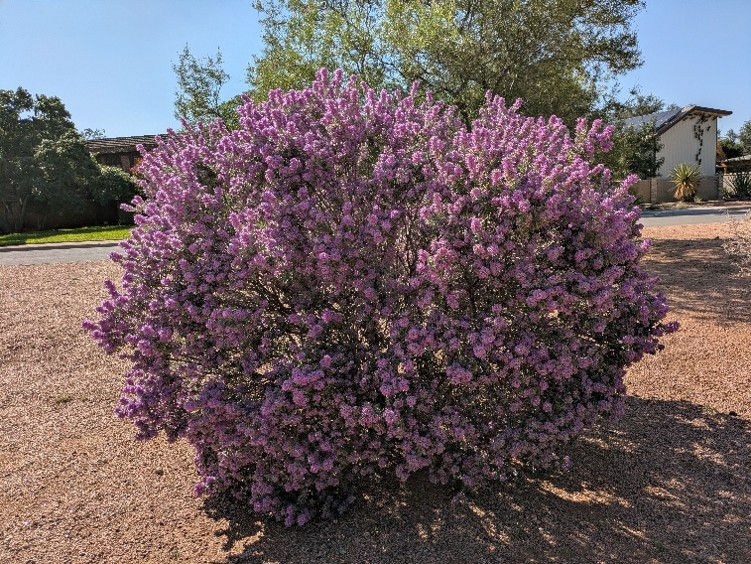
Photo by Emmy Ulmschneider
By Emmy Ulmschneider, Permian Basin Master Gardener
If you drove around our Midland-Odessa area in late July, you may have noticed the plethora of beautiful blooming bushes in all shades of purple, and you might have wondered what they are and why they were blooming. The simple answer is they are all members of the genus Leucophyllum and are commonly called Cenizo or Barometer Bush. Members of this genus tend to bloom in periods of high humidity associated with rain, hence the name Barometer Bush. They all have certain characteristics in common: silvery grey colored leaves and beautiful blooms in all shades of purple. In fact, their genus name, Leucophyllum, comes from the Greek leucos, white, and phyllon, leaf. They are not technically sages but belong to the Scrophulariaceae, or Figwort Family. You might be familiar with another member of the Figwort family, Buddleia or Butterfly Bush.
These hardy, beautiful, evergreen shrubs have become garden staples across the arid Southwest, thriving in our calcareous soil and dry, hot conditions. Leucophyllums are very drought tolerant and, in home gardens, can be susceptible to root rot from inadvertent overwatering. There are roughly fifteen to seventeen species and about as many different cultivars, technically nativars, as they are derived from a native species. The most common nativars come from Leucophyllum frutescens, a Texas native, commonly known as Texas Sage, Ranger, Cenizo, Silverleaf, or Barometer Bush. This species is the official "State Native Shrub of Texas". The species name frutescens comes from Latin and means "to become shrubby." This cenizo is the one most often seen in our landscapes, with bloom colors ranging from white to pink, and lavender to violet. It is also one of the largest; Leucophyllum frutescens can reach up to 10 feet tall. In our landscapes, they are often pruned into hedges or smaller compact shapes. Common nativars include ‘Green Cloud’ and ‘Compacta’.
One cenizo I enjoy in my garden is Leucophyllum langimaniae ‘Lynn’s Legacy’, a Texas Superstar designated primarily for its profuse, frequent, and humidity-independent flowering. Its pale lavender blooms contrast delicately with its very light, silver-gray leaf color. ‘Lynn’s Legacy’ is named for Lynn Lowery, a celebrated Texas botanist, known as the father of the Texas native plant movement. An interesting side note: the species name, langmaniae, is named for Ida Kaplan Langman, a Russian-born American botanist who collected in Mexico during the 1940s.
In addition to their showy, attractive blooms, cenizios have wildlife value. Their conspicuous flowers are butterfly magnets, and they provide cover and shelter, as well. If they bloom during peak butterfly season, butterflies cluster around the shrub, making it look alive with movement.
So, if you have a dry, sunny area and want an easy-to-grow, showy plant with wildlife value, try a cenizo. You’ll be glad you did.
If you have questions, call the AgriLife office in Odessa at 498-4071 or in Midland at 686-4700. Additional information, and our blog for access to past articles, is available at westtexasgardening.org. Click on “Resources".

Photo by Emmy Ulmschneider


