Connections in Native Gardens

By Emmy Ulmschneider, Permian Basin Master Gardener
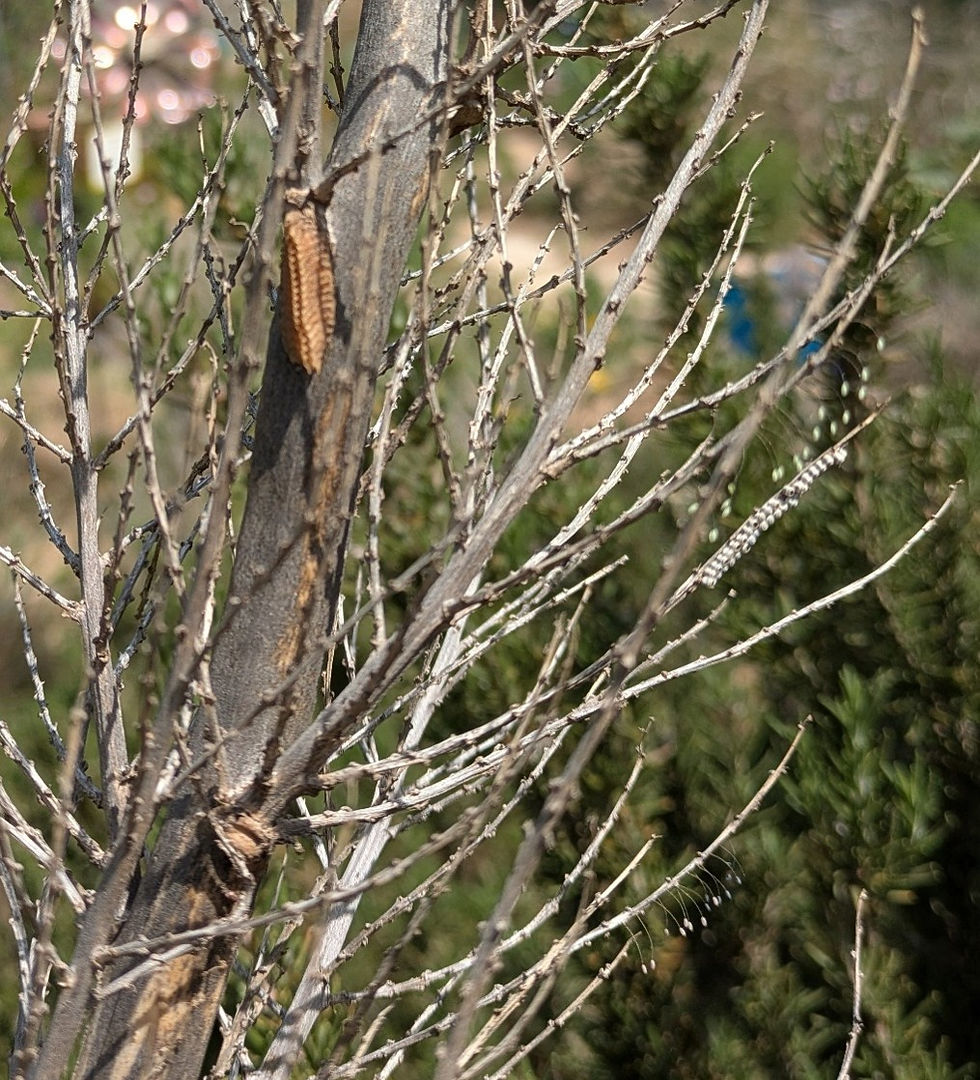
I am always amazed by the connections between native plants and the organisms they support. As I started to cut back last year’s dried flower stalk from my Saccahuista or Beargrass, Nolina microcarpa, I noticed that both a praying mantis and a green lacewing had chosen to lay their eggs on the old flower stalk. This plant has a long human connection as well. The common name Saccahuista is derived from two Aztec words meaning thorn grass. Native Americans used Nolina leaves for basketry and the bud stalks for food. Across the dry, arid southwest, there are several species of Nolina. AlthoughN. microcarpa is native to Arizona, there are about four other Nolina species that are native to Texas, look similar, and were used in similar ways. The Texas species range from the High Plains and the Edwards Plateau to the Rio Grande area. Supposedly, N. microcarpa is the most grass-like and has the softest leaves. The leaf margins of some Nolina species are serrated like a sharp, toothed knife and can cut unwary fingers. My favorite characteristic of N. microcarpa is the way the leaf tips end with curling fibers almost as if the leaves themselves were becoming unraveled. Despite their shared common name of Beargrass, Nolina spp. are in the lily family, Liliaceae, and are not true grasses. All the species have similar-looking bloom spikes and growth forms, although the bloom spikes often remain nestled within the leaves. I have grown this plant since 2012, but only in the last few years has it started to bloom. This spring, I watched as four bloom spikes emerged, grew well beyond the leaves to about twelve feet tall, and then blossomed. As the flowers matured, they attracted a host of bee and fly pollinators, and they provided a focal point for the rest of my native garden.
Praying mantises are a common sight in my garden, and I usually find them on unexpected surfaces, such as concrete block fences or garden sculptures. I always wonder how the female selects a site for her egg case. Less common are the delicate stalked lacewing eggs, which I often find adhering to my clothesline. Lacewings, often referred to as garden fairies, are another highly beneficial, but perhaps less well-known insect. Because their larvae feed on aphids, thrips, and mites, lacewings are recognized as a biological control for undesirable insect pests. You can even purchase lacewing eggs or larvae commercially, and unlike ladybugs, they do not fly away! When I find lacewing adults or eggs in my garden, I am always pleased, as lacewings are often seen as symbols of positive change and protection. And perhaps that is what a native garden brings. It reminds us that even in our stagnant, unmoving urban landscapes, we can find life, connection, and balance.
If you have questions, call the AgriLife office in Odessa at 498-4071 or in Midland at 686-4700. Additional information and our blog for access to past articles are available at westtexasgardening.org. Click on “Resources".