Growing Gardeners

By Brandy Goodman, Permian Basin Master Gardener Intern
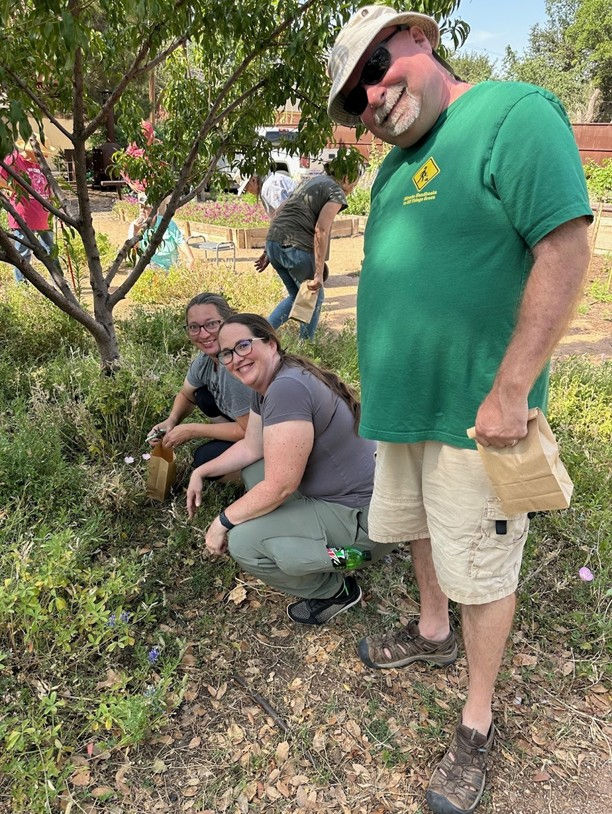
This summer at Goodman Gardens, I had the opportunity to teach a JMG Literature in the Garden program. I had about a dozen students from 4 to 84. No, that is not a typo. This group of learners was as young as 4 and as wise and experienced as 84. By classroom standards, this group fell WAY outside the target age bracket, yet each participant fit the script.
I chose The Gardener by Sarah Stewart for its award-winning illustrations, which the kids were encouraged to recreate. We painted a beautiful 6 ft long tapestry with watercolors to demonstrate a color palette for the garden. The youngest used their fingers to imprint petals and swiped their palms for stems.
The story’s setting is the Great Depression, when foods like bread and rice were rationed, and supplies ran low. The elders in the summer garden group offer insight into what it was like to live through such hard times. The main character moves to the city while her father looks for work. She is inventive in choosing her containers for planting and finds that anything that holds soil and drains water can be used to grow food and flowers. Her collection brings joy to her family and others in the town in a time when hardships were overwhelming for most. We placed seeds of marigolds, zinnias, and even sprigs of Aloe in colanders, a tea kettle, and even boots. One of the kids was elated in coining the term “Crockpot” for his wheatgrass seeds that he planted in a pair of crocks!
In the book Weslandia by Paul Fleisman, Wesley was bored and lonely but creative. He discovered a mysterious bumper crop and created an entire civilization throughout his summer school project. Like Wesley, we planted a Sunflower crop and used every part for different purposes. Suddenly, a seed isn’t merely something to plant. It can become food, shelter, creativity, experimentation, and imagination.
The learners kept nature journals describing and recording a life based on the sunflower, starting with the nourishing seeds inside the disk florets as a protein-packed food source. We built jars of trail mix with mixed nuts and fruits to share underneath the green garden arbor as we planned our next exercise.
We pressed the yellow pigment from the beautiful flower petals to create textiles to wear or use for working the crop. The sweet perfume invited us to use the sunflower oil, which has many uses for food prep and other handmade body products. While some of the kids tested their dexterity and wove stems together for a basket, others harvested the seeds to regrow our crops in succession so that our life source was renewable and would produce another generation of plants.
Somewhere in those hours together, I began to notice that I wasn’t simply teaching children how to grow flowers in a garden. I was watching the garden grow something in us too. We were teaching them how to interact with and care for the natural world.
A garden asks a child to look closely. What changed? What’s growing? Who ate that leaf? Where did that worm come from? Why did this seed sprout while that one didn’t? What’s happening beneath the soil where we can’t see it? And perhaps the most important question of all: What happens if I take care of this?
Gardening gives children something increasingly rare—a chance to experience a process they cannot hurry. It takes curiosity to return to the scene for answers, and literature gave us another way into those conversations. But some of the best lessons in a garden aren't found in a book-they're discovered through trial, error, and a little dirt under your fingernails.
Plants get overwatered. Seeds don’t always go exactly where you intended. Tiny seedlings occasionally encounter very enthusiastic little hands. But even those moments become part of the education. A garden is remarkably forgiving that way.
By the end of our summer program, the learners went home with completion certificates, adorable “GardenNERD” t-shirts, and packets of seeds. Junior Master Gardeners were equipped and excited to try it at home.
But I’ve found myself thinking about the other things they carried home that couldn’t be tucked into a seed packet. Perhaps one child will look differently at a bee after learning what it is doing on a flower. Perhaps another will recognize a plant growing along a sidewalk and stop to investigate instead of walking past it or stepping on it, taking the time to use a magnifying glass or other identification method. Perhaps he will save a seed from a flower or vegetable and discover that next year’s garden can begin with something this year’s garden produced. And perhaps she will consider planting her seeds in a nontraditional place like a teacup or a boot, enhancing the space around her for others to enjoy.
That’s how gardeners are grown. Not necessarily through perfect rows, perfect plants, or perfectly planned lessons. The calendar, season, and schedule don't always get the right of way. Sometimes it begins with a story and a seed. Sometimes it begins when a lesson plan gets completely interrupted because somebody found a worm. You can put a seed into the ground. You can provide good soil, water, and sunlight. You can protect it and tend it. But you cannot make it grow by Tuesday.
You have to come back. That waiting creates opportunities for observation, responsibility and curiosity in ways that are difficult to reproduce inside a classroom. There is something wonderfully unpredictable about putting a group of children in a garden. You can prepare the lesson, gather the supplies, choose the book, organize the activity, and plan every minute of the afternoon. And then somebody finds a worm!
Suddenly, the lesson has changed. It has come to include ALL things living and inspires a series of minilessons unintended for class that day. This is my FAVORITE part of teaching in a garden- the best lessons are often the ones I never planned. This summer with my nature newbies and my seasoned seniors is one I will never forget.
If you have questions, call the AgriLife office in Odessa at 498-4071 or in Midland at 686-4700. Additional information and our blog, with access to past articles, are available at westtexasgardening.org. Click on “Resources”.